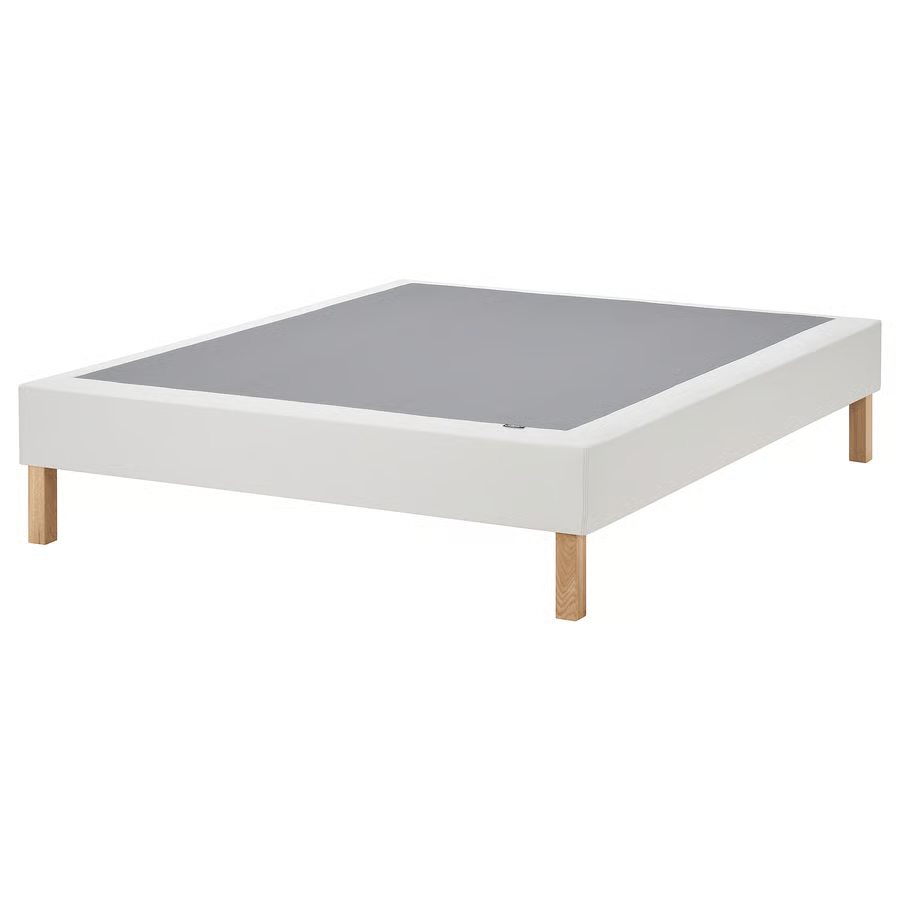
You have just invested in a new mattress — or you are about to do so — and the question inevitably arises: should you change the box spring at the same time? It is a significant additional expense, and the answer is not always obvious. However, it directly affects the comfort you will get from your purchase, the longevity of the mattress, and even the validity of its warranty. This guide helps you make an informed decision based on the condition of your current box spring, its compatibility with your new mattress, and what manufacturers say.
The box spring: a foundation, not an accessory
We tend to think of the box spring as a simple passive support, a structure that we only need to worry about if it creaks or collapses. This is a mistake. A worn or unsuitable box spring can reduce the effectiveness of a new mattress, create uncomfortable pressure points, and accelerate its wear. A new mattress placed on a damaged box spring can quickly lose its firmness and support.
In other words, if your box spring is in poor condition, you risk immediately compromising the investment you have just made — even if your mattress is excellent on paper.
Mattress-box spring compatibility: what manufacturers don’t always clearly state
Mattress technologies have their preferences. Foam or latex mattresses appreciate the stability of slats, while spring mattresses need support that respects their elasticity and ventilation. If the duo is not well matched, both comfort and lifespan suffer.
Here are the main compatibility rules to remember in 2026:
Foam or latex mattresses
These mattresses need a rigid and uniform support. A slatted base with slats spaced less than 6 cm apart is generally recommended, or a box spring (which forms a continuous surface). Avoid slats that are too widely spaced, which create unsupported pressure zones and gradually deform the foam.
Pocket spring or open spring mattresses
These mattresses work best with a box spring that allows them freedom of movement and ensures good ventilation. A slatted base with flexible slats is perfect; a very rigid box spring, on the other hand, can diminish the suspension properties of the spring.
Hybrid mattresses
Combining springs and foam (or latex), they tolerate a wider variety of box springs, but checking the manufacturer’s recommendations is still essential. Always consult the manual or product sheet.
In case of doubt, refer to the advice in our dedicated section to find the box spring suitable for your configuration.
The warranty: a often underestimated point
This is where the question of the box spring becomes really critical. The warranty from the mattress manufacturer is often conditioned on the use of a compatible box spring: a poor match can completely void your rights in case of a defect.
Warranty conditions vary by brand, but it is common for manufacturers to require that the mattress be used “on a box spring in good condition” for the warranty to remain valid. The warranty does not apply if the conditions are not met. This means that if you report abnormal sagging or premature deformation, but your box spring has broken slats, deformation, or visible wear, the manufacturer has the right to reject your claim.
Before purchasing your mattress, take the time to carefully read the warranty conditions. They usually specify what type of box spring is required (maximum number of slats, spacing, rigid or flexible surface). This is not a trivial clause: on a high-end mattress with a 10-year warranty, failing to meet these conditions can represent a significant financial loss.
View on AmazonAssessing the condition of your current box spring
Changing the box spring is not always necessary. If one of the two items suddenly breaks two or three years after purchase, it is not necessary to buy the complete set again. The real question is: is your current box spring still capable of fulfilling its role properly?
Here are the concrete signs that indicate it is time to replace it:
- Broken or permanently bent slats. A broken slat creates a localized sagging area that will immediately impact the new mattress placed on top.
- A frame that creaks, deforms, or has visible play. Nocturnal noises are not just a sound nuisance: they signal a structure that has lost its rigidity.
- A surface that is generally sunken or sagging. If the box spring has a dip in the center — where the body weight concentrates each night — it can no longer provide uniform support.
- A box spring older than 10 to 15 years. Even without apparent defects, the materials (wood, fabric, foam for upholstered models) wear out. A very old box spring will struggle to optimize the performance of a new mattress.
- A box spring that does not match the type of mattress purchased. If you are switching from a spring mattress to a foam mattress, your current box spring may no longer be suitable.
Conversely, if your box spring is recent (less than 5 years), in good structural condition, and its configuration is compatible with the new mattress, it does not need to be replaced immediately. A careful examination is sufficient.
View on AmazonBuying together or separately: the two scenarios
Buying mattress and box spring at the same time
Changing both the box spring and mattress at the same time guarantees optimal compatibility between the two elements. An appropriate box spring can extend the lifespan of the mattress and maximize its performance. It is also often an opportunity to benefit from promotions: manufacturers often offer specific discounts on sets. Before deciding, compare the price of the set to the cumulative cost of the two items purchased separately — the difference can be significant, especially during sales or major year-end promotional events.
Simultaneous purchase also has a practical advantage: both items are delivered together, they share the same start date, and your next replacement decision will be simplified.
Keeping the existing box spring
If your box spring passes the inspection described above, keeping it is entirely reasonable. Just make sure to check two non-negotiable points: the condition (no broken slats, no sagging) and compatibility with the type of mattress purchased. If in doubt about compatibility, contact the customer service of your mattress manufacturer — they can confirm whether your current box spring meets warranty requirements.
Find a slatted box spring on Amazon.frWhat French regulations say about warranties
In France, every consumer product benefits from the legal warranty of conformity (2 years) and the warranty against hidden defects, regardless of the manufacturer’s commercial warranty. These legal warranties cannot be waived by a contractual clause. However, the extended commercial warranty — the one that manufacturers highlight (5, 10, or even 15 years) — is subject to their own usage conditions. It is this warranty that can be invalidated if you use an unsuitable or damaged box spring.
So read the fine print before buying. The clauses related to the box spring are almost always included.
Summary: what to do concretely?
| Situation | Recommendation |
|---|---|
| Recent box spring (< 5 years), in good condition, compatible | Keep the existing box spring |
| Box spring aged 5 to 10 years, in apparent good condition | Inspect carefully before deciding |
| Box spring over 10 years or with visible defects | Replace at the same time as the mattress |
| Changing type of mattress (e.g.: springs → foam) | Check compatibility, adapt if necessary |
| Manufacturer warranty requiring a specific box spring | Meet the requirements or risk invalidation |
FAQ
Is my mattress warranty really voided if I keep my old box spring?
This is a very real possibility, and it is often underestimated when purchasing. The extended commercial warranty of a mattress — often 10 years or more — is a contractual warranty whose conditions are set by the manufacturer. Almost all manufacturers require that the mattress be used on a box spring in good condition and compatible with the mattress technology. If you report a defect (abnormal sagging, premature deformation) and your box spring has broken slats, a deformed frame, or visible wear, the manufacturer can legitimately reject your claim by citing non-compliance with usage conditions. The legal warranty of conformity (2 years), however, cannot be waived — but it only covers defects of conformity observed within two years of purchase, not wear over time. To protect your investment in the long term, always check the warranty conditions before buying, and keep your order receipt as well as photos of the box spring’s condition at the time of installation.
Can a foam mattress be placed directly on the floor or on a platform?
Technically, yes — but with significant reservations. Placing a foam mattress directly on the floor eliminates any ventilation underneath the mattress, which encourages moisture accumulation, mold development, and the appearance of dust mites. In the long term, this degrades the mattress much faster than using a box spring. A bed platform (flat and rigid surface) is an acceptable alternative, provided it is sufficiently ventilated and that its surface does not have rough edges that could damage the mattress cover. Also, check that your mattress manufacturer validates this type of support in their warranty conditions: some explicitly allow it, while others exclude it. If you opt for an upholstered box spring, ensure it has enough legs to prevent any sagging of the central platform under weight.
What is the average lifespan of a box spring?
A good quality box spring can last between 10 and 15 years if used under normal conditions. That said, the actual lifespan depends a lot on its construction (solid slatted base vs. plywood slats, upholstered with quality padding or not), the weight of the users, and the frequency of use. Entry-level box springs, often built with lighter materials, show signs of wear more quickly — sometimes as early as 7 to 8 years. An early warning sign is noise: regular creaking indicates material or assembly fatigue. In practice, it is reasonable to reassess the condition of the box spring at the time of each mattress change, even if the two events do not necessarily coincide.
Is a slatted box spring always better than an upholstered box spring?
No, it depends on the type of mattress and your sleeping habits. The slatted box spring offers better ventilation, which is particularly appreciated for memory foam mattresses — which tend to retain heat. It also adapts better to spring mattresses by allowing them to work freely. The upholstered box spring, on the other hand, provides a flat and firm surface that is perfect for natural latex mattresses, which are often heavier and require uniform support. Some sleepers who suffer from back pain also find more comfort on the firmness of an upholstered model. The choice is therefore not universal: consult the recommendations of your mattress manufacturer, and consider your preferences regarding overall firmness of the sleeping surface.
Is buying a mattress + box spring set cheaper than buying the two separately?
Not necessarily, but it is common. Bedding sets are often offered with a specific discount compared to the cumulative price of the two items purchased individually. Before opting for a set, carefully compare: add the price of the mattress alone and that of the box spring alone, then compare to the bundled offer. The difference can vary depending on periods (sales, special promotions) and retailers. Also consider the logistical practicality: simultaneous delivery, collection of the old bedding, and warranty starting on the same date for both items.
Can I use a box spring from a different brand than my mattress?
Yes, nothing technically or legally prohibits it. There is no obligation to purchase within the same brand universe. What matters is functional compatibility: the type of box spring (slats, upholstered, springs), the spacing of the slats, the rigidity of the surface, and the overall condition of the box spring. However, always check the warranty conditions of your mattress: some manufacturers specify the technical characteristics of the required box spring without imposing their own brand, while others may be more restrictive. In case of doubt, a simple written request to the manufacturer’s customer service will allow you to obtain an official response that you can keep in case of a future dispute.
What should I do if my box spring is still in good condition but incompatible with my new mattress?
In this case, several options are available to you. The first is to adapt the box spring: if it is a matter of slat spacing, it is sometimes possible to add slats to fill in the gaps that are too wide — some bedding sellers offer slats individually. If it is a question of surface type (upholstered vs. slats), adaptation is more complex and replacement will often be more sensible. The second option is to reconsider your choice of mattress: if you have not yet purchased, choose a model explicitly compatible with your current box spring. In any case, never place a mattress on an incompatible support hoping that it will “work anyway”: it is comfort, lifespan, and warranty that will suffer.