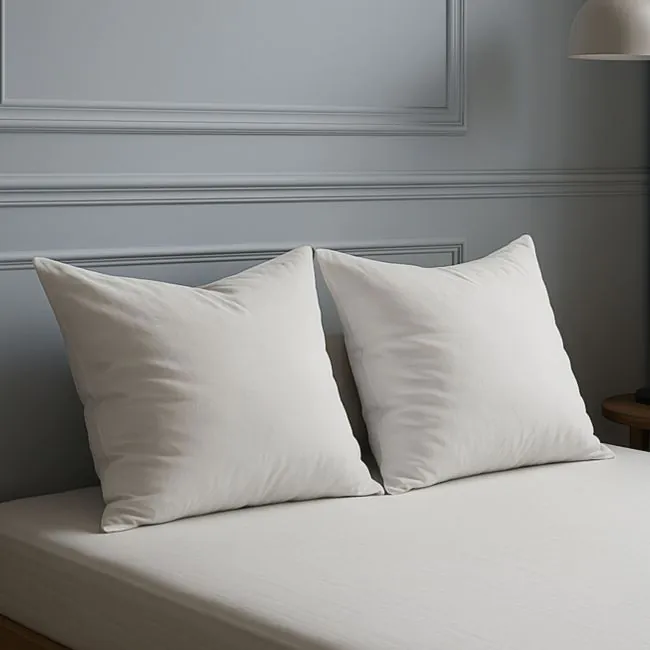
The choice of a pillow is crucial for sleep quality. However, faced with the variety of materials available, a common question arises: should one opt for a natural or synthetic pillow? This decision, which may seem secondary, actually impacts nighttime comfort, bedding hygiene, health (especially in cases of allergies), and even the environment. This comparison aims to help you see clearly.
To go further on the subject, also check out our complete guide to choosing your mattress and our selection of the best pillows tested by our team .
Quick Comparison Summary
| Criterion | Natural Pillow | Synthetic Pillow |
|---|---|---|
| Materials | Feathers, down, latex, wool, kapok | Polyester fibers, microfibers, foam |
| Comfort | Soft, adaptive, breathable | Homogeneous, customizable |
| Maintenance | More delicate, often non-washable | Easy to maintain, washable at 40 °C |
| Lifespan | 3 to 5 years (latex: up to 8 years) | 1 to 3 years depending on quality |
| Hypoallergenic | Yes (latex, kapok) | Yes if treated against dust mites |
| Environment | Renewable, biodegradable | Non-renewable, petroleum-derived |
| Price | Higher | Affordable |
Presentation of Compared Options
Natural Pillows
Natural pillows are made from animal-based materials (feathers, down, wool) or plant-based materials (natural latex, kapok). Their main appeal lies in their biodegradable composition, natural thermal regulation, and adaptive comfort.
Examples:
- Down Pillow: very soft, breathable
- Natural Latex: firm, hypoallergenic
- Kapok: plant-based alternative to down, light and breathable
- Wool: good thermal insulator, adaptive
Synthetic Pillows
Synthetic pillows are made from polyester fibers, microfibers, or memory foam. They are very popular for their affordable price, ease of maintenance, and hypoallergenic nature (if treated).
Examples:
- Microfiber: soft, washable
- Memory Foam: ergonomic, precise support
Detailed Point-by-Point Comparison
Comfort and Sleeping Feel
- Natural: provide a cocoon-like feeling, natural softness.
- Synthetic: more standardized comfort, warmer foam.
Firmness and Support
- Natural: varies according to filling (latex = firm, down = very soft).
- Synthetic: firmness adjustable based on technology (ergonomic = targeted support).
Adaptation to Body Shape
- Natural: good compromise with latex and kapok.
- Synthetic: memory foam = optimal adaptation.
Thermal Regulation
- Natural: excellent regulators (down, wool, kapok).
- Synthetic: can retain heat, except for ventilated versions.
Durability and Maintenance
- Natural: sensitive to moisture, durable if well maintained.
- Synthetic: easily washable, but compress quickly.
Environmental Impact
- Natural: low impact (biodegradable, recyclable).
- Synthetic: petroleum-based, rarely recycled.
Budget / Value for Money
- Natural: more expensive but more durable.
- Synthetic: economical, but frequent replacement.
How to Choose According to Your Profile?
Specific Needs
- Night Sweats: kapok, latex, wool
- Allergies: natural latex or treated synthetic pillow
- Neck Pain: memory foam or latex
- Soft Comfort: down or soft microfibers
Environment
- Warm Climate: kapok, down
- Shared Room: latex (stable, silent)
Priorities
- Budget: mid-range synthetic
- Durability: natural latex
- Eco-Responsibility: kapok, wool, latex, or certified down
Expert Tips
Tips for Testing a Technology
- In-store: test in back and side positions for at least 5 minutes.
- Online: check the return policy (minimum 14 days).
Common Mistakes to Avoid
- Choosing a pillow too firm for a light body type
- Confusing softness with support
- Ignoring sensitivity to heat
Questions to Ask Yourself
- Do I have neck pain upon waking?
- Do I sweat a lot?
- Am I prone to allergies?
- What is my primary sleeping position?
FAQ
What is the average lifespan of a pillow?
- Synthetic: 1 to 3 years
- Natural latex: up to 8 years
- Down/feather: 3 to 5 years
Are pillows compatible with all bed bases?
Yes. Their effectiveness depends on the mattress and posture, not the bed base.
How to maintain a natural pillow?
- Use a protective cover
- Air regularly
- Check machine compatibility before washing
Is a natural pillow necessarily hypoallergenic?
No, only natural latex and kapok are naturally hypoallergenic. Down may cause issues for some sensitive individuals.
How often should you replace your natural or synthetic pillow?
A synthetic pillow should be replaced every 1 to 3 years, as the fibers compress and lose support. A natural latex pillow can last up to 8 years if a protective cover is used and it is aired regularly. For down or feather pillows, replacement every 3 to 5 years is recommended. A simple test: if the pillow does not regain its shape after compression, it is time to change it.