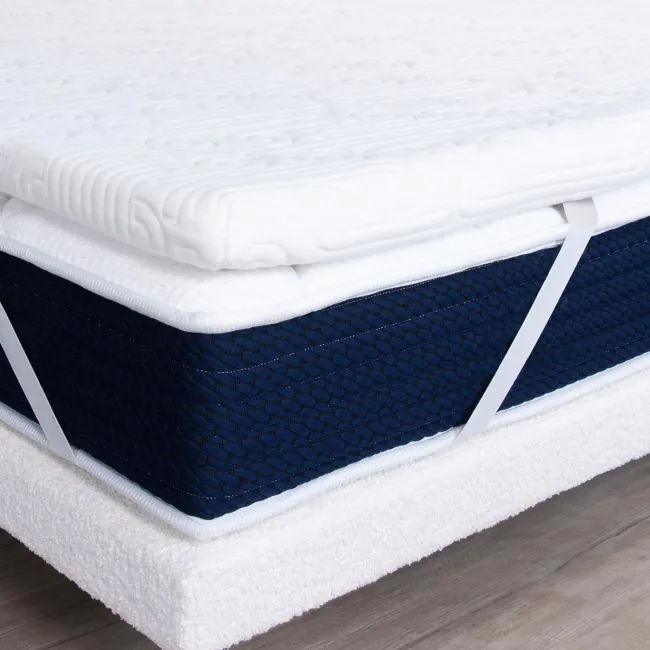
The natural mattress topper is becoming an increasingly popular alternative for sleepers seeking sustainable and responsible comfort. However, latex, wool, and bamboo do not meet the same needs or budgets: expect to pay around €40 for an entry-level bamboo mattress topper, €80–180 for wool, and €150–350 or more for certified natural latex. Here is our comparative guide to make an informed choice.
Comparative Table of Natural Materials
| Criteria | Natural Latex | Wool | Bamboo |
|---|---|---|---|
| Comfort | Elastic, high support | Soft, enveloping | Soft, light |
| Firmness | Medium to firm | Soft to firm | Flexible to medium |
| Thermoregulation | Good | Excellent | Good |
| Maintenance | Average (dense) | Delicate (dry cleaning) | Easy (washable) |
| Durability | 10+ years | 5–10 years | 5–7 years |
| Ecology | Biodegradable, certified | Local, renewable | Renewable, processing to monitor |
| Budget | Starting from ~€150 | Starting from ~€80 | Starting from ~€40 |
Presentation of Compared Options
Natural Latex Mattress Topper
Made from rubber tree sap, the natural latex mattress topper ideally benefits from GOLS (Global Organic Latex Standard) or EUROLATEX certifications, which guarantee the biological origin of the material. Its great elasticity and excellent morphological support make it the reference choice for sleepers who want to enhance the support of their spine without resorting to synthetic foam. Its exceptional longevity — often exceeding ten years — also makes it a cost-effective investment over time, despite a higher initial cost.
View on AmazonWool Mattress Topper
Wool is a remarkable natural thermal insulator: it regulates body heat both in winter and summer, absorbing moisture without feeling suffocating. The cocoon-like sensation it provides is particularly appreciated by chilly sleepers or those seeking enveloping comfort. To preserve its qualities, it should be turned regularly and machine washing should be avoided — dry cleaning or simple airing is sufficient in most cases. French wool (merino, Lacaune) also offers a reduced carbon footprint and supports local industries.
Bamboo Mattress Topper
Bamboo fiber, transformed into viscose or lyocell (the latter being the most environmentally friendly version), produces soft, breathable, and very easy-to-maintain mattress toppers. It is the most financially accessible option and best suited for those who suffer from night sweats, provided that a lyocell cover is chosen instead of standard viscose, which undergoes a more intensive chemical transformation. Particularly suitable for lightweight individuals and hot sleepers.
Compare natural bamboo and lyocell mattress toppers on AmazonDetailed Comparison
Comfort and Feel
Latex offers a characteristic buoyant feeling: the body is well supported without sinking in. Wool, on the other hand, provides a cocooning sensation conducive to relaxation, ideal for those who like to feel enveloped. Bamboo, for its part, is distinguished by its great lightness and immediate softness to the touch, without providing structural support.
Support and Morphology
Natural latex is the only one of the three materials to offer truly effective lumbar support, comparable to that of high-density foam. Wool is more variable depending on the weight: a mattress topper of 1 kg/m² or more will be more structuring than a lighter model. Bamboo, being soft by nature, is more suitable for lighter builds or for those whose main mattress is already quite firm.
Thermoregulation
Wool remains the champion of thermal regulation, thanks to its ability to absorb up to 30% of its weight in moisture without appearing wet. Bamboo (lyocell), on the other hand, is very breathable and quick-drying. Natural latex, although aerated by its honeycomb structure, can be slightly warming for very hot sleepers.
Maintenance
The bamboo mattress topper is the easiest to maintain: machine washable at 30–40 °C for most models. Wool requires more precautions (dry cleaning recommended, flat drying). Latex, dense and heavy, is not very manageable to wash; it is generally limited to airing out and treating stains locally.
Durability
Certified natural latex can easily exceed ten years of service with minimal maintenance. Well-maintained and regularly turned wool lasts five to ten years. Bamboo, a mechanically more fragile material, typically needs to be replaced after five to seven years.
Eco-responsibility
Certified GOLS latex is the most virtuous solution throughout its life cycle — biodegradable, sourced from organic and sustainable farming. French wool represents a local and renewable resource with a low logistical footprint. Bamboo grows quickly without pesticides, but its transformation into viscose involves significant chemical solvents; prefer lyocell (TENCEL™ closed-loop process) to limit this impact.
View on AmazonWhich natural mattress topper according to your profile?
Specific needs
For people who sweat a lot at night, bamboo (lyocell) and wool are the best options due to their natural moisture management. In cases of persistent lower back pain, firm natural latex provides the necessary support to relieve back tension. Allergy sufferers should be cautious: some untreated wools may contain irritating residues; in this case, latex or bamboo with OEKO-TEX Standard 100 certification are safer alternatives.
Climate environment
In a context of warm nights or poorly ventilated housing, bamboo is preferable to wool. The latter makes sense in cool bedrooms or regions with harsh winters, where its insulating properties make a difference. For a shared bed, latex stands out for its excellent motion isolation: one sleeper’s movements disturb the other little.
Personal priorities
A tight budget will naturally lean towards bamboo, without sacrificing immediate comfort. Those committed to eco-responsibility will prefer GOLS certified latex or local wool. For those primarily seeking longevity, natural latex remains the most cost-effective investment in the long run.
To compare other models and read detailed reviews, check out our complete section on mattress toppers .
Expert Tips
Always check certifications before purchasing: GOLS for latex, GOTS and/or OEKO-TEX Standard 100 for textiles. Don’t be swayed by generous thickness if the material density is insufficient — a 3 cm layer of latex at 65–70 kg/m³ will always perform better than a 7 cm layer of low-density foam. Avoid plasticized or waterproof covers if you tend to sweat: they negate the breathable properties of the underlying natural material. Finally, some manufacturers and specialized retailers offer home trial periods: take advantage of this, as the feel when lying down is the only truly reliable measure of comfort.
FAQ
What is the lifespan of a natural mattress topper?
The lifespan of a natural mattress topper varies significantly depending on the chosen material. Certified natural latex is the most durable: with proper care, it easily lasts over ten years without notable loss of support. Wool lasts between five and ten years, provided it is regularly flipped and aired out each season, which prevents fiber compression. Bamboo, being mechanically more fragile, typically needs to be replaced after five to seven years. In any case, a topper placed on a sagging mattress will age prematurely: ensure that the base is in good condition to maximize the longevity of your investment.
Can a natural mattress topper be placed on any mattress?
In the vast majority of cases, yes — a mattress topper is placed directly on the main mattress. However, there are two important conditions to meet. First, the base mattress must not be sagging or deformed: the topper does not correct a worn mattress; it enhances one that is still in good condition. Secondly, a thick latex topper on a very soft spring mattress may excessively alter the perceived firmness; in this case, it is better to choose a thinner model (3 cm) or opt for a wool or bamboo topper, which are more adaptable to various bases.
How to maintain a wool mattress topper?
The wool mattress topper requires attentive but low-maintenance care on a daily basis. Regularly airing it out — ideally once a month outside or at an open window — is sufficient to eliminate accumulated moisture and prevent the development of dust mites. For localized stains, dab with a slightly damp cloth and mild soap, without rubbing. Avoid machine washing, which can felt the fibers and irreparably deform the product; professional dry cleaning once a year is preferable. Also, remember to flip it from side to side every three months to ensure even wear and prevent compression.
Is a natural mattress topper dust mite resistant?
Some natural materials have properties that are naturally unfavorable to dust mites. Natural latex, due to its density and closed structure, provides an inhospitable environment for these allergens. Bamboo (lyocell) is known for its mild antibacterial properties, although studies on this point remain nuanced. Untreated wool, on the other hand, can harbor more dust mites if not aired out regularly. In any case, prioritize models with the OEKO-TEX Standard 100 certification, which guarantees the absence of harmful chemicals, and complement with a protective cover if you are highly allergic.
What certifications should you look for in a natural mattress topper?
Certifications are your most reliable compass for distinguishing a truly natural product from one that is simply presented as such. For latex, the GOLS (Global Organic Latex Standard) certification ensures that the latex comes from organic rubber tree cultivation, free from pesticides or synthetic fertilizers, and that manufacturing processes adhere to strict social and environmental standards. For textiles like wool or bamboo, the GOTS (Global Organic Textile Standard) label covers the entire production chain, from field to label. The OEKO-TEX Standard 100, which is less demanding on origin but very rigorous on chemical safety, is a minimum recommended for any mattress topper in direct contact with the skin, especially in cases of allergies.
What thickness should you choose for a natural mattress topper?
The ideal thickness of a natural mattress topper depends on the desired effect and the base mattress. For a simple comfort boost without altering the overall firmness of the bed, a thickness of 3 cm is generally sufficient, especially for latex or wool. If the goal is to "revive" a mattress that is too firm or to correct a slight loss of plushness, a thickness of 5 to 7 cm will be more suitable. However, be careful not to exceed this value for a bamboo topper, as its soft structure at great thickness can harm lumbar support. Heavier individuals (over 90 kg) would benefit from choosing a good density latex (minimum 65 kg/m³) rather than bamboo, to maintain adequate support.