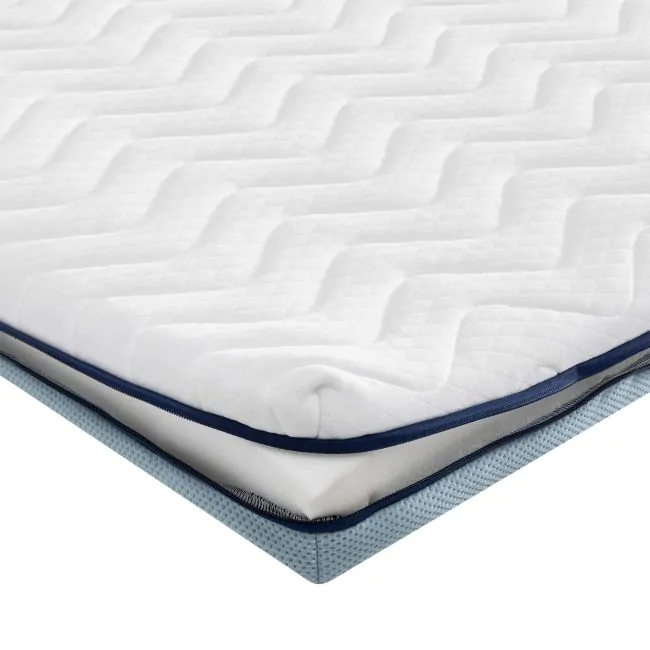
The memory foam mattress topper is often presented as the miracle solution to improve a mattress that is too firm or aging. But is it really suitable for all sleepers? Let’s compare it to other technologies (latex, fibers, traditional foam) to help you choose the best option.
To complete your reflection, consult our complete guide to choosing your mattress and our dedicated article on how to choose your mattress if you have back pain .
Comparative table of major mattress topper families
| Criterion | Memory Foam | Latex / Fiber / Polyester |
|---|---|---|
| Comfort | Contouring, relieves pressure points | Firmer or bouncy depending on the material |
| Support | Morphological, adaptive | Firm or elastic |
| Thermoregulation | Can retain heat | Better ventilation (latex, fibers) |
| Durability | Good if density ≥ 50 kg/m³ | Good depending on quality |
| Maintenance | Limited to removable cover | Easier to maintain |
| Price | Medium to high (starting from ~€100) | Variable (fibers from ~€50, latex ~€200–300) |
| Environmental Impact | Low-recyclability synthetic foam | More eco-friendly natural latex |
| Compatibility | All mattresses except very soft ones | Variable depending on thickness/material |
Memory Foam Mattress Topper: Overview
The memory foam mattress topper is made of viscoelastic foam, a material that reacts to body heat to precisely adapt to the curves of the sleeper. This thermo-sensitive behavior gives it unique properties in bedding: where traditional foam offers uniform resistance, viscoelastic foam gradually sinks under the heaviest areas — shoulders, hips, lower back — and gently rebounds as soon as the pressure ceases.
This technology is praised for its cocooning effect that promotes relaxation, its ability to relieve pressure points, and its adaptation to body shape, especially in cases of back pain or joint sensitivity. It is particularly suitable for side sleepers, whose hips and shoulders experience the most significant impact.
However, memory foam does have some important limitations to be aware of before purchasing. It tends to retain body heat, which can be uncomfortable for those who sweat a lot at night. It is less suitable for restless sleepers, as its slow response time can create a feeling of being stuck during frequent position changes. Finally, synthetic foam remains difficult to recycle at the end of its life, making it a less environmentally friendly choice compared to natural latex.
View on AmazonOther Types of Mattress Toppers: Alternatives
The market offers three main families of alternatives to memory foam, each catering to a different sleeper profile.
The latex mattress topper provides elastic and dynamic rebound, superior natural ventilation, and remarkable durability. Natural latex is also sourced from a renewable resource, making it the most eco-friendly option. Its price is generally higher, but the longevity often compensates for the initial investment.
Fiber mattress toppers (polyester, microfiber, synthetic down filling) are lightweight, hypoallergenic, and easy to machine wash for many models. They primarily add extra softness and fluffiness, without claiming to offer true morphological support. Their lifespan is shorter, but their entry price is accessible to all budgets.
Standard foam (conventional polyurethane) occupies the entry-level segment: firm, basic, and inexpensive. It is suitable as a temporary or supplementary solution, lacking the morphological adaptation of memory foam and the resilience of latex.
Detailed Comparison
Comfort & Feel
Memory foam provides a sensation of gradual enveloping, particularly appreciated for calm nights and sleepers suffering from muscle tension. The body slowly sinks into the foam, which then forms a personalized “mold” relieving pressure points. Latex, on the other hand, offers a more dynamic and bouncy comfort, similar to that of a natural spring — ideal for those who prefer to feel that they are “resting on” their bedding rather than “in” it. The fibers provide a fluffy softness but lack the anatomical structuring of these two materials.
Support & Firmness
In terms of support, memory foam excels at relieving pressure points, especially for side sleepers. Dense latex ensures good support for the entire body, with an almost immediate recovery of shape after each movement. The fibers, being softer and less structuring, are primarily suitable for a mattress that is already supportive, where one wishes to add a layer of comfort.
Thermoregulation
Thermoregulation is the historical weak point of memory foam: viscoelastic foam forms a close envelope around the body that limits air circulation. Manufacturers are seeking to address this through integrated gel technologies, open cells, or breathable fabric covers — options to prioritize if you tend to sweat at night. Latex and fibers naturally offer better ventilation, with natural latex in particular benefiting from a porous structure that facilitates thermal exchanges.
Durability & Maintenance
The lifespan of a good quality memory foam mattress topper is estimated at 5 to 8 years, provided a sufficient density is chosen. Below 40 kg/m³, the foam collapses prematurely; models at 50 kg/m³ and above offer a much better quality/lifespan ratio. Latex is even more durable, often exceeding 10 years for well-maintained natural latex. Fibers, on the other hand, compress more quickly and require more frequent replacement. For regular maintenance, a removable and washable cover is essential on any memory foam mattress topper.
Budget & Environment
In terms of budget, memory foam mattress toppers start at around ~€100 for small sizes, with quality models for a 140 × 190 cm typically ranging between €150 and €250. Natural latex involves a higher investment, justified by its longevity and favorable ecological footprint. Fibers remain accessible from around ~€50, but their short lifespan diminishes the initial savings.
View on AmazonWhich mattress topper according to your profile?
Specific needs
The choice of a mattress topper should be guided by your actual physiological needs. If you suffer from excessive sweating, standard memory foam is not recommended: prefer latex or breathable microfiber, or even a memory foam topper equipped with a gel system. In case of back or joint pain, dense memory foam or latex are the best options, provided that your current mattress is not already too soft. People with allergies should opt for covers made from natural materials, latex, or certified hypoallergenic microfiber. Heavy sleepers (over 90 kg) must prioritize a high density (≥ 50 kg/m³) to avoid premature sagging.
Sleep environment
If your bedroom is naturally warm or poorly ventilated, latex or microfiber will be preferable to classic memory foam. On the other hand, if you share your bed and are sensitive to your partner’s nighttime movements, memory foam remains unbeatable: its ability to absorb motion transfer significantly reduces sleep disturbances.
Purchase objective
For a small budget, classic foam or fibers are a good starting point. If ecology is your priority, natural latex is the way to go. To maximize longevity while benefiting from morphological comfort, dense memory foam or dense latex remain the best long-term investments.
Expert Tips
Before any purchase, check the density displayed by the manufacturer: 50 kg/m³ is the benchmark for a durable memory foam mattress topper, and the absolute minimum is 40 kg/m³. Below this, the foam will quickly lose its memory and sag in less than two years.
Avoid mattress toppers that are too thick (beyond 7 to 8 cm) if your mattress is already soft: combining two soft layers may disrupt the overall ergonomics of the bed and worsen back pain instead of alleviating it. A topper of 4 to 6 cm is generally sufficient for most sleepers.
Always look for a breathable and removable cover, ideally made of quilted or honeycomb fabric with gel reinforcements, to limit heat retention. A zipper on three sides makes it easier to remove and wash regularly, which is essential for maintaining good bedding hygiene.
Search for a memory foam mattress topper on Amazon.fr — wide selection of sizes and densitiesFAQ
What is the lifespan of a memory foam mattress topper?
A good quality memory foam mattress topper typically lasts between 5 to 8 years, compared to 3 to 5 years for entry-level models. This lifespan mainly depends on the density of the foam: a model with 50 kg/m³ or more will resist sagging much better than a model with 35 kg/m³. Maintenance also plays a crucial role — airing out the topper regularly, flipping it every three to six months, and using a washable cover significantly slow down the aging of the foam. Conversely, a poorly ventilated topper or one exposed to moisture will degrade much faster. If you notice permanent indentations or a significant loss of bounce, it's time to replace it regardless of its age.
Can you put a memory foam topper on any mattress?
Memory foam pairs well with most mattresses in good overall condition, whether they are spring, foam, or latex. The golden rule is simple: the supporting mattress must remain firm enough to provide structural support for the back, with the topper only serving as a comfort layer. On a mattress that is too soft or has sagging indentations, adding a memory foam topper does not fix anything — it conforms to and even amplifies the surface defects, which can worsen back pain. In this case, replacing the mattress is inevitable. In terms of technical compatibility, toppers equipped with corner straps or a non-slip side fit all types of bedding, including existing memory foam mattresses.
How to maintain a memory foam mattress topper?
Regular maintenance significantly extends the lifespan of the topper. In practice: remove and wash the removable cover every four to six weeks at the temperature indicated by the manufacturer (usually 40 °C). Air out the topper itself by placing it upright for a few hours, ideally once a month, to release residual moisture accumulated during sleep. Avoid folding or tightly rolling it at all costs, as viscoelastic foam can retain a permanent deformation if constrained for too long. Never machine wash or soak it: the foam absorbs liquids and takes days to dry, which promotes mold growth. In case of a stain, gently dab with a damp cloth and mild soap, then let it air dry.
Is a memory foam mattress topper effective against back pain?
Yes, in many cases. Viscoelastic foam relieves pressure points by conforming to the body's natural curves, reducing tension on the lower back, shoulders, and hips. This technology is particularly beneficial for side and back sleepers. However, if your back pain is related to a lack of support (too soft mattress), a memory foam topper may worsen the problem. Also, check out our guide on choosing a mattress for back pain for a comprehensive approach.
How do I know if I need a mattress topper?
Several signs indicate that a mattress topper may improve your comfort: you wake up with muscle or joint pain, your mattress feels too firm upon waking, you have difficulty finding a comfortable position in the evening, or your mattress is over 5 years old and starting to lack softness. Conversely, if your mattress is too soft or sagging, a topper will not compensate for this structural problem — a replacement will be necessary. The topper is ideal as an optimization solution on a mattress that is still in good condition but slightly uncomfortable.
What thickness should I choose for a memory foam mattress topper?
The ideal thickness for a memory foam mattress topper generally ranges between 4 and 7 cm, depending on your body type and the firmness of the supporting mattress. Below 4 cm, the morphological effect remains limited: the body does not sink enough for the foam to fully perform its decompression role. Beyond 7 to 8 cm, the risk is to weaken the overall support of the bedding, especially on a mattress that is already soft. Sleepers under 70 kg will be fine with a model of 4 to 5 cm; heavier profiles (over 90 kg) will benefit from opting for 6 to 7 cm to avoid the foam becoming saturated too quickly. In any case, ensure that your bed base or frame can accommodate the total height of the bedding without overflow.