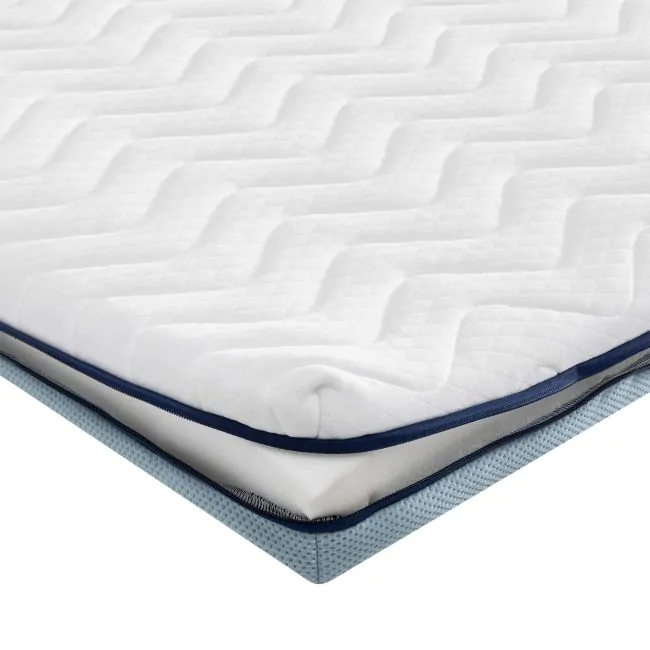
The memory foam mattress topper is often presented as the miracle solution to improve a mattress that is too firm or aging. But is it really suitable for all sleepers? Let’s compare it to other technologies (latex, fibers, conventional foam) to help you choose the best option.
To complete your reflection, check out our complete guide to choosing your mattress and our dedicated article on how to choose your mattress in case of back pain .
Comparative table of major families of mattress toppers
| Criterion | Memory Foam | Latex / Fiber / Polyester |
|---|---|---|
| Comfort | Enveloping, relieves pressure points | Firmer or bouncier depending on material |
| Support | Morphological, adaptive | Firm or elastic |
| Thermoregulation | Can retain heat | Better ventilation (latex, fibers) |
| Durability | Average to good | Good depending on quality |
| Maintenance | Limited to removable cover | Easier to maintain |
| Price | Medium to high (€100–250) | Variable (fibers from €50, latex €200–300) |
| Environmental Impact | Low-recyclability synthetic foam | Natural latex more eco-friendly |
| Compatibility | All mattresses except very soft ones | Variable depending on thickness/material |
Memory foam mattress topper: presentation
The memory foam mattress topper is made of viscoelastic foam. It reacts to body heat and adapts to its shape. This technology is praised for:
- Its cocoon effect that relaxes
- Its ability to relieve pressure points
- Its adaptation to morphology, especially in cases of back pain
But it also has some limitations:
→ Retains heat
→ Less suitable for restless sleepers
→ Not very recyclable
Other types of mattress toppers: alternatives
- Latex: bouncy, elastic, more ventilated, durable
- Fibers (polyester, microfiber): lightweight, hypoallergenic, good loft
- Conventional foam: firm, basic, inexpensive
Detailed comparison
Comfort & sensation
- Memory Foam: enveloping sensation, ideal for calm nights
- Others: dynamic latex, softer fibers but less structured
Support & firmness
- Memory Foam: excellent relief for pressure areas
- Latex: good support
- Fibers: softer, less structuring
Thermoregulation
- Memory: tends to retain heat
- Latex/fibers: better natural ventilation
Durability / Maintenance
- Memory: depends on density (prefer >40 kg/m³)
- Latex: very durable
- Fibers: more sensitive to wear
Budget & environment
- Memory Foam: good compromise if of decent quality
- Natural Latex: more expensive, but eco-friendly
- Fibers: affordable, but not very durable
Which mattress topper according to your profile?
Specific needs
- Excessive sweating: avoid memory foam → prefer latex or microfiber
- Back pain: memory foam or dense latex
- Allergies: natural covers, latex or certified microfiber
- Heavy build: high density essential
Sleep environment
- Warm room: latex or microfiber
- Shared bed: memory foam to limit movements
Purchase goal
- Small budget: conventional foam or fibers
- Ecology: natural latex
- Longevity: latex or dense memory foam
Expert advice
- Choose the right density: minimum 40 kg/m³ for durability
- Avoid overly thick mattress toppers: risk of disrupting overall ergonomics
- Look for options with gel or breathable cover to limit heat
FAQ
What is the lifespan of a memory foam mattress topper?
About 3 to 5 years for good models. Longer if well ventilated and maintained.Can you put a memory foam mattress topper on any mattress?
Yes, except on mattresses that are too soft or sagging, as this distorts support.How to maintain a memory foam mattress topper?
Air it out regularly, use a washable cover, and avoid folding it to prevent damage.Is a memory foam mattress topper effective against back pain?
Yes, in many cases. The viscoelastic foam relieves pressure points by conforming to the body's natural curves, reducing tension on the lower back, shoulders, and hips. This technology is particularly beneficial for side and back sleepers. However, if your back pain is related to a lack of support (too soft mattress), a memory foam mattress topper may exacerbate the problem. Also, check our guide on choosing a mattress for back pain for a comprehensive approach.
How do I know if I need a mattress topper?
Several signs indicate that a mattress topper may improve your comfort: you wake up with muscle or joint pain, your mattress feels too firm or hard upon waking, you have trouble finding a comfortable position in the evening, or your mattress is over 5 years old and starting to lack softness. Conversely, if your mattress is too soft or sagging, a mattress topper will not compensate for this structural problem — a replacement will be necessary. The mattress topper is ideal as an optimization solution on a mattress that is still in good condition but slightly uncomfortable.